In 2026, the US business landscape is defined not just by innovation, but by hyper-saturation and speed. For American enterprises, securing a new contract or closing a series-round funding is no longer just about the strength of the core offering. It is about the persuasive power of the documentation that introduces it.
The traditional 30-page, text-heavy business proposal is obsolete. The modern proposal must be agile, data-centric, and intensely personalized to the decision-maker’s immediate pain points. If your proposal feels like a template, it will be treated as one. To secure a foothold in a projected US GDP environment that values digital integration and transparent operations, the structure of your pitch must evolve.
The Shift: What Defines “Winning” in 2026?
A winning proposal in 2026 is an ecosystem, not a document. It is a synthesis of market intelligence, client psychology, and projected ROI. For US founders, intrapreneurs, and project managers, the challenge is articulating complex strategies within increasingly short decision cycles.
As decision-makers increasingly utilize AI-based screening tools to filter initial vendors, the human touch—the ability to tell a compelling story rooted in hard data—becomes the critical differentiator. Many organizations struggle to strike this balance. To gain a competitive edge in the crowded market, many leaders rely on expert business proposal writing services to ensure their submissions align with the exacting standards and regulatory landscape of the 2026 environment. A professional’s perspective is often required to move from generic assertions of value to the specific, measurable impact that American stakeholders demand.
The stakes are higher because the competition is better informed. Access to predictive analytics and comprehensive market intelligence is now standard, making the proposal itself the primary tool for demonstrating superior operational competence.
Anatomy of the 2026 Business Proposal
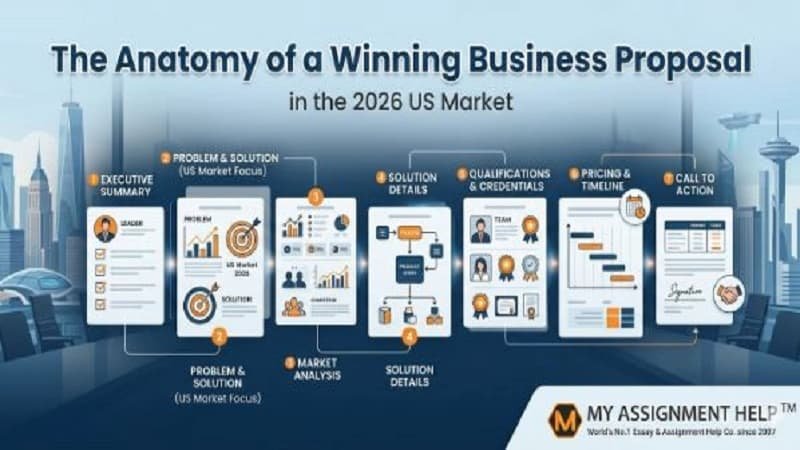
A winning proposal is structured sequentially to guide the client from a state of identified need to a state of confident resolution.
1. The Executive Summary: The $10,000 Hook
The Executive Summary must be a concise distillation of the entire value proposition. By 2026 standards, if the reader cannot grasp the potential ROI and time-to-value within the first 60 seconds, they will not read further. It should not be a ‘summary’ as much as it is a persuasive argument for reading the details.
2. Client-Centric Problem Statement
Successful proposals in the US market do not sell solutions; they diagnose problems better than the client themselves. This section must use data—industry benchmarks, the client’s public performance metrics (if available), and market gap analysis—to define the challenge in stark terms. It is about demonstrating that you understand their unique vertical and the current market pressures.
3. The Solution (Articulated as a Value Proposition)
This is where you define how your product or service addresses the diagnosed problem. Crucially, the focus must be on outcomes, not features. In 2026, the discussion should include integration capabilities (API capabilities, IoT connectivity, or AI compliance) which are paramount in a connected operational environment.
4. ROI & Predictive Data Analytics: The Validation (Sources and References)
The “Implementation” section of 2024 has become the “Validation” section of 2026. US firms now make decisions based on predictive modeling.
You must provide rigorous, validated data. For instance, if you are pitching a sustainability solution, referencing projected energy cost savings validated by the US Department of Energy benchmarks (e.g., referencing DOE’s projected commercial energy price changes for 2026) builds immense credibility. If pitching a workforce optimization tool, utilization of US Bureau of Labor Statistics (BLS) productivity data for relevant NAICS codes demonstrates macroeconomic competence.
For detailed methodologies on initiating a successful client outreach strategy that leads to a request for this validated data, see our comprehensive guide on how to start an email to decision-makers.
5. Timeline, Milestones, and Risk Mitigation
Operational transparency is non-negotiable in the US market. A detailed timeline (often using Gantt charts or agile sprint maps) is essential. What sets a winner apart is the Risk Mitigation subsection. You must address the “What Ifs”—market volatility, supply chain disruptions, or regulatory changes—demonstrating that your solution is robust and that your team is proactive, not just reactive.
6. The Terms, Conditions, and Digital Call to Action (CTA)
Ensure legal requirements specific to your industry and the state you are operating in are included. The final element is a seamless CTA. In 2026, this means a digital signature link, a calendly booking for a final confirmation meeting, or a secure payment portal link for an initial deposit. Remove all friction from the closing process.
Key Takeaways for the 2026 US Market
| Aspect | 2024 Standards | 2026 Standards | Strategic Shift |
| Length | Comprehensive (25+ pages) | Agile (8–12 pages, high-density) | Prioritize clarity and impact over bulk. |
| Data | Historical performance data. | Predictive analytics and modeling. | Sell the future, validated by the present. |
| Tone | Professional, informative. | Persuasive, partnership-oriented. | Become a strategic ally, not a vendor. |
| Call to Action | “Contact us for a meeting.” | Frictionless, digital acceptance/next step. | Close the deal digitally and immediately. |
| Format | Static PDF/Print. | Interactive Web-based or AI-optimized. | Use technology to enhance engagement. |
FAQ: Navigating Proposal Development in 2026
Q: In a high-speed market, do I still need a comprehensive, long-form proposal?
A: No. You need an agile, high-density proposal. The goal is to provide deep value quickly. Stakeholders value conciseness. A 10-page document packed with validated ROI modeling is vastly superior to a 30-page document filled with fluff.
Q: How often should I include third-party data or references?
A: In 2026, every major claim must be validated. A good rule of thumb is one credible, relevant source (government data like BLS/DOE, major market research firms like Gartner/McKinsey, or academic studies) for every critical data point or projection made in the proposal. This passes both human and AI scrutiny.
Q: If I’m a small company, how do I compete with the polish of large corporations?
A: Focus on hyper-personalization. Large corporations often rely on templates. A small, agile firm can win by demonstrating that they understand the client’s specific operational pain points better than anyone else. Additionally, you can utilize specialized services like proposal writing and market research to match the operational polish of larger competitors without the same overhead.
About the Author
Dr. Anya Sharma is a Senior Strategy Analyst at MyAssignmentHelp. She holds a Ph.D. in Organizational Leadership with a focus on business communication dynamics within the digital economy. With over 12 years of experience analyzing corporate growth strategies and market trends in the US, Dr. Sharma works to synthesize complex organizational theories into actionable business practices. Her research emphasizes the role of precise, data-driven documentation in securing investment and driving B2B growth. See more